Tools To Use
Therapy tools can play a vital role in improving mental health, building emotional strength, and helping you track personal growth. Myers Counseling Group offers therapeutic tools that may assist clients. We recommend using these tools in collaboration with your therapist. They are designed to support the therapeutic process, not replace it.
back to top
Anger
This worksheet provides examples of how adopting a different mindset can help you work through frustration.
A visual aid explaining how anger can build into a toxic feedback loop.
Anxiety
A weekly log that helps you gauge how you felt during different activities.
Anxiety Feedback Loop Worksheet
A worksheet designed to help you better understand how anxiety presents itself.
A detailed explanation of what the brain and body experience during stress.
An illustration demonstrating how we can get stuck in decision-making.
This worksheet offers steps to help manage intrusive thoughts.
A handout on how to approach and manage anxiety and panic attacks.
Cognitive Behavioral
A diagram that breaks down emotional disturbance and the steps one can take to manage it.
A framework for understanding three options that are available in any situation.
A worksheet used to promote positive change and build motivation.
A chart describing potential positive and negative outcomes related to changing a behavior or improving a family dynamic.
A description of relapse and the cycle that requires awareness and learning.
Ref: Social Work Change! (Adapted from text by Prochaska and DiClemente)
A worksheet to support mindful responses to events and the feelings they create.
A flowchart illustrating negative self-talk and the downward spiral it can create.
Developing Your Arsenal Against Negative Thoughts
A strengthening worksheet that helps identify negative thoughts and steps to manage them.
A helpful tool for setting goals and identifying steps to accomplish them.
A brief guide about the positive impact of pushing through negative feelings.
A journal tool to support appreciation and positive focus.
A write-up explaining how to journal and the positive effects it can have.
Principles Underlying Functional Thinking
A six-point description of personal strength and what it takes to build a functional mindset.
Couple
Worksheet designed to resolve disagreements between two parties.
Decreasing Criticism and Judgement in Your Relationship
A worksheet designed to help take a step back and reduce sources of conflict.
Ref: Between Sessions Resources
A worksheet that supports mindful responses to events and the feelings they create.
Ref: Parlay International
A guide describing thoughts and feelings that contribute to breakdowns in communication.
A tool for de-escalating arguments and disagreements and creating space for more productive communication.
Depression
Developing Your Happiness Intelligence
A worksheet exploring the concept of happiness and ways to build it.
Ref: Between Sessions Resources
A worksheet designed to help occupy and uplift the user.
Ref: Between Sessions Resources
A journal intended to support noticing daily moments of gratitude.
Guaranteed Ways to Make Yourself Miserable
A list that helps identify how certain patterns of thinking and decision-making can increase negativity.
A tool that can help you find comfort in stressful situations.
Ref: Between Sessions Resources
A tool that helps you assess how you’re doing across seven areas of wellness.
Family
A worksheet designed to recognize unhealthy patterns when responding to a loved one’s mental health or substance misuse challenges.
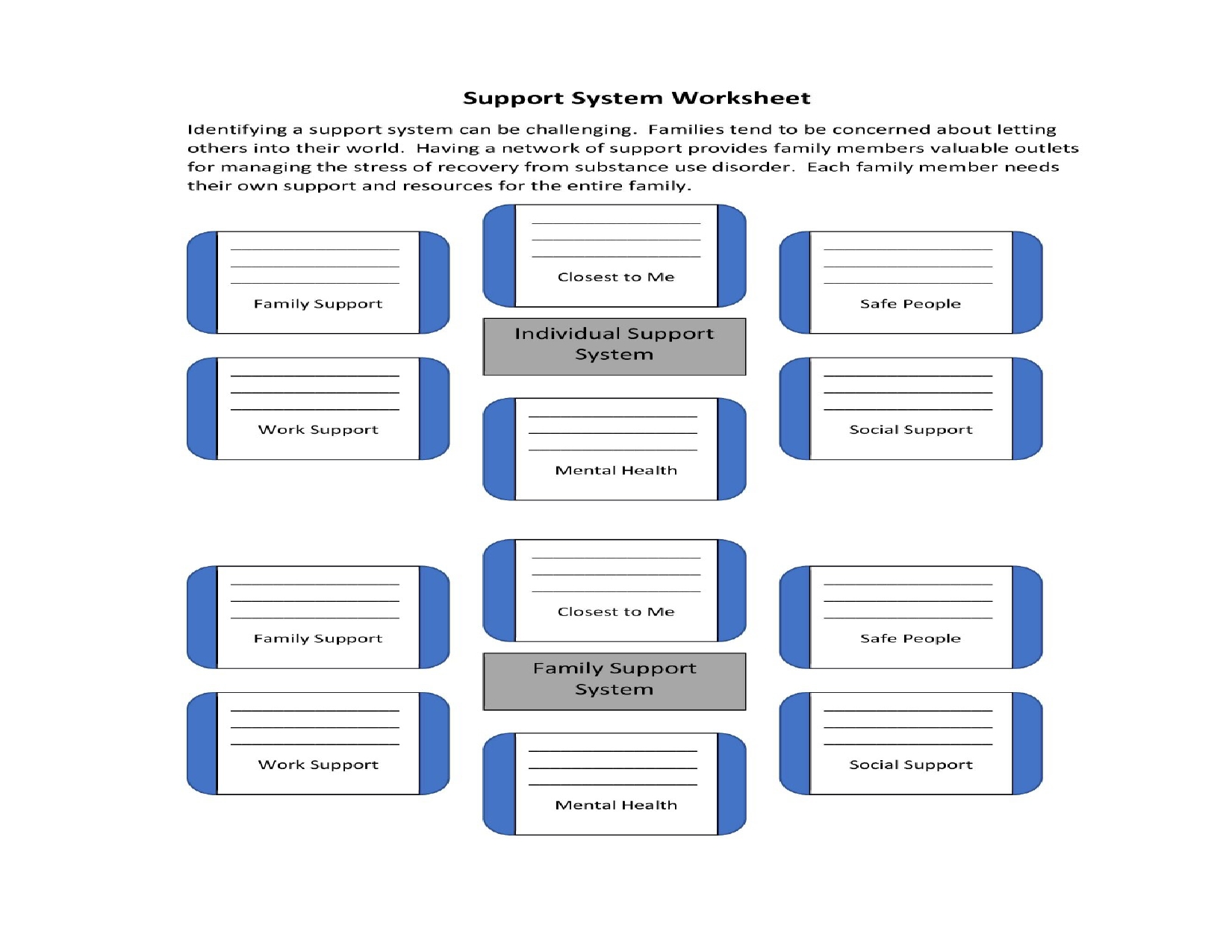
A worksheet designed for families supporting a loved one with a mental health or substance use disorder.
Four Stages of Substance Use Recovery for Families
A worksheet designed to help families understand the stages they may experience when facing a substance use disorder.
A tool to help families work together and communicate more effectively.
A worksheet designed for individuals working through shame-related concerns.
A worksheet designed to help children understand actions and outcomes.
Ref: Between Sessions Resources
A guide to grief and different types of loss.
Ref: Center for Clinical Interventions
A comprehensive overview of grief and what it can involve.
Ref: TherapistAid
Mindfullness/Relaxation/Breathing
Breathing plays an important role in managing mental health. When we are stressed or physically exerting ourselves, we often breathe rapidly from the chest, an automatic response. These breathing techniques can help manage anxiety, stress, and other concerns.
Designed to redirect attention. Shifting your focus can help calm the mind and reconnect with your environment.
A description of mindfulness and the impact it can have.
Ref: Center for Clinical Interventions
Our Brains Interpreting the Environment
A handout explaining how the brain responds to the environment.
A document designed to help identify steps toward building self-love.
Self-Confidence
A page focused on recognizing that positive change is possible.
A worksheet for shifting self-talk and increasing positive emotions.
Ref: Between Sessions Resources
Guidelines for Effective Self Promotion
A tool for building a positive self-image and reinforcing constructive messaging.
Ref: REBT Resource Book
Thoughts to Help Increase Self-Acceptance
A write-up on why negative self-talk occurs and how to address it.
Ref: REBT Resource Book
Sleep
Tips that explain how and why sleep matters, along with strategies to improve it.
Stress
A list of tools that can help reduce stressors and support coping.
Substance Abuse
A worksheet to help log alcohol use and related patterns.
A tool for understanding alcohol limits and potential effects.
Ref: Moderation Management
Methods to help recover from triggers and prevent relapse.
Ref: F. Michler Bishop, REBT Resource Book for Practitioners, 2000
A document designed to help evaluate motivation and support continued progress in recovery.
A handout describing different paths toward recovery.
A worksheet designed to identify values and conflicts related to substance use.
Three C’s of Recovery for Families
Challenges the belief that families can cause, cure, or control a loved one’s substance use.
Explains the difference between returning to substance use by choice versus slipping (“falling off the wagon”).
Data from the 2015 National Alcohol Survey (NAS) examines average weekly alcohol consumption among women and men across the United States.
Other
Determining the appropriate level of care can be challenging. This handout helps weigh the pros and cons of different levels of care.
Explains the differences among types of drug screens that are available.